

Learn how to pay your Scapia Credit Card bill payment using available payment methods, understand the minimum amount due and avoid late payment charges.
Apply for the Scapia Credit Card
Zero Forex Markup on international spends, unlimited domestic lounge access, and Lifetime Free guarantee.
Scapia Credit Card bill payment can be made through the available payment options provided for cardholders. The billing statement is available through email and the Scapia app, while payments can be made using a debit card, net banking or UPI.
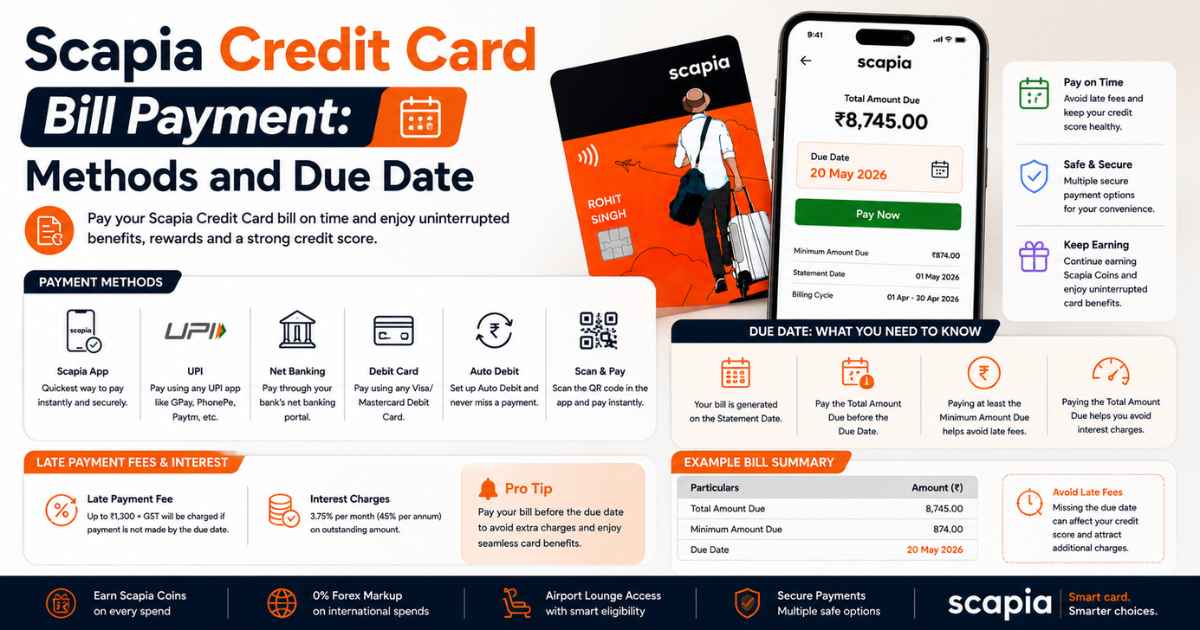
Paying the bill on time is important because unpaid dues can attract finance charges and late payment charges. This guide explains the available payment methods, minimum amount due, payment timing and important conditions.
Scapia Credit Card Bill Payment – Quick Answer
You can pay your Scapia Credit Card bill using:
- Debit card
- Net banking
- UPI
Your billing statement is provided through email and the Scapia app. The statement shows the amount payable, minimum amount due and applicable payment details.
For the best way to avoid finance charges on regular purchases, pay the total amount due by the payment due date.
Scapia Credit Card Bill Payment Methods
Scapia provides multiple ways to make your credit card payment. The available card terms specifically mention debit card, net banking and UPI as payment methods.
Debit Card
You can use a debit card to make your Scapia Credit Card bill payment through the available payment facility.
Before making the payment, check the amount shown in your latest statement and ensure that the payment is completed before the due date.
Net Banking
Net banking is another payment option available for paying your Scapia Credit Card bill.
You can use your bank account’s net banking facility through the applicable payment process. Keep your card and payment details available when making the payment.
UPI
UPI can also be used for Scapia Credit Card bill payments.
This can be convenient when you prefer making payments directly through a UPI-enabled banking or payment application.
If you want to understand UPI usage with the card itself, read our Scapia Credit Card UPI guide.
How to Pay Your Scapia Credit Card Bill
The general payment process is straightforward:
- Check your latest Scapia Credit Card statement.
- Note the total amount due and payment due date.
- Choose an available payment method such as debit card, net banking or UPI.
- Enter the required payment details.
- Pay the amount shown on your statement.
- Keep the payment confirmation for your records.
The exact screens and steps can vary depending on the payment method you use.
Where Can You Check Your Scapia Credit Card Bill?
Your billing statement is provided through email and the Scapia app.
The statement is important because it shows your outstanding amount, minimum amount due and other applicable charges.
Review your statement before making a payment, particularly if you have made refunds, EMI transactions, cash withdrawals or other transactions that can affect the amount payable.
You can also read our Scapia Credit Card status guide if you need information about tracking your card or application status.
What Is the Minimum Amount Due?
The minimum amount due is the minimum payment required according to the applicable billing calculation.
Under the available card terms, the minimum amount due includes 2% of retail spends and cash advances, along with 100% of applicable fees, charges, finance charges, GST and EMI amounts. A minimum amount of ₹200 applies, subject to the stated conditions.
The exact amount payable will be shown on your billing statement.
Should You Pay the Total Amount Due or Minimum Amount Due?
Paying the total amount due is generally important if you want to avoid finance charges on eligible retail purchases.
Paying only the minimum amount due can leave part of your outstanding balance unpaid. Finance charges can then apply according to the applicable card terms.
The available terms state that the interest rate for revolving credit is 45% per annum or 3.75% per month.
Therefore, the minimum amount due should not be treated as the recommended amount to pay when you can clear the full outstanding balance.
What Happens If You Miss the Payment Due Date?
Missing the payment due date can result in late payment charges and applicable finance charges.
The late payment charge depends on the outstanding amount:
| Outstanding amount | Late payment charge |
|---|---|
| Less than ₹100 | Nil |
| ₹100 to ₹500 | ₹100 |
| ₹501 to ₹1,000 | ₹400 |
| ₹1,001 to ₹10,000 | ₹750 |
| ₹10,001 to ₹25,000 | ₹950 |
| ₹25,001 to ₹50,000 | ₹1,100 |
| Above ₹50,000 | ₹1,300 |
Applicable GST may also be charged on fees and other applicable charges.
These charges are based on the available card terms and may change if the applicable terms are revised.
What Is the Interest-Free Period?
The Scapia Credit Card provides an interest-free period of up to 50 days, subject to the applicable conditions.
The available terms describe this as a 30-day billing cycle followed by a payment period of up to 20 days.
However, the interest-free period depends on paying previous dues in full. If the required amount is not paid, finance charges can apply according to the applicable terms.
This is different from cash withdrawals, which do not receive an interest-free period.
You can read our Scapia ATM withdrawal charges guide to understand the costs associated with cash withdrawals.
Important Things to Remember
Keep these points in mind when making your Scapia Credit Card bill payment:
- Check your statement before making the payment.
- Note the payment due date carefully.
- You can use debit card, net banking or UPI.
- Paying only the minimum amount due can leave an outstanding balance.
- Finance charges can apply to unpaid amounts.
- Late payment charges depend on the outstanding amount.
- GST applies to applicable fees, interest and charges.
- Cash withdrawals have separate interest and fee conditions.
- Keep your payment confirmation after completing a payment.
How Can You Avoid Credit Card Payment Charges?
The simplest way to reduce the risk of finance charges is to pay the total amount due by the payment due date.
Regularly checking your statement can also help you identify unexpected charges, refunds or transactions before the payment deadline.
If you are planning your card expenses, understanding the Scapia Credit Card fees and charges can help you account for applicable costs.
FAQs About Scapia Credit Card Bill Payment
-
How can I pay my Scapia Credit Card bill?
The available payment methods include debit card, net banking and UPI. Your billing statement is available through email and the Scapia app.
-
Can I pay my Scapia Credit Card bill through UPI?
Yes. UPI is one of the payment methods available for Scapia Credit Card bill payment.
-
Can I pay the bill using a debit card?
Yes. Debit card payment is one of the available payment methods.
-
What happens if I pay only the minimum amount due?
Paying only the minimum amount due can leave part of your balance outstanding. Applicable finance charges can then apply according to the card terms.
-
What is the Scapia Credit Card interest rate?
The applicable revolving interest rate is 45% per annum, or 3.75% per month.
-
What is the maximum interest-free period?
The interest-free period can be up to 50 days, subject to the applicable conditions and payment of previous dues in full.
-
What happens if I miss my payment due date?
A late payment charge can apply based on the outstanding amount. Finance charges may also apply according to the applicable terms.
-
Where can I check my Scapia Credit Card statement?
The billing statement is provided through email and the Scapia app.
Final Takeaway
Scapia Credit Card bill payment can be made through debit card, net banking or UPI. Your statement is available through email and the Scapia app, where you can check the amount due and payment details.
Paying the total amount due by the payment due date can help you avoid applicable finance charges on eligible purchases. If you cannot pay the full balance, understand the minimum amount due and the potential interest before making your payment.