

Check Scapia Credit Card eligibility for 2026: age limit, income requirement, credit score, and documents for Federal, Axis, and Bank of Baroda variants.
Apply for the Scapia Credit Card
Zero Forex Markup on international spends, unlimited domestic lounge access, and Lifetime Free guarantee.
The Scapia Credit Card is a lifetime-free travel credit card with zero forex markup, but approval is not automatic. Scapia is a fintech brand – the card itself is issued by partner banks, currently Federal Bank, Axis Bank, and Bank of Baroda. The exact eligibility rules depend on which bank issues your card.
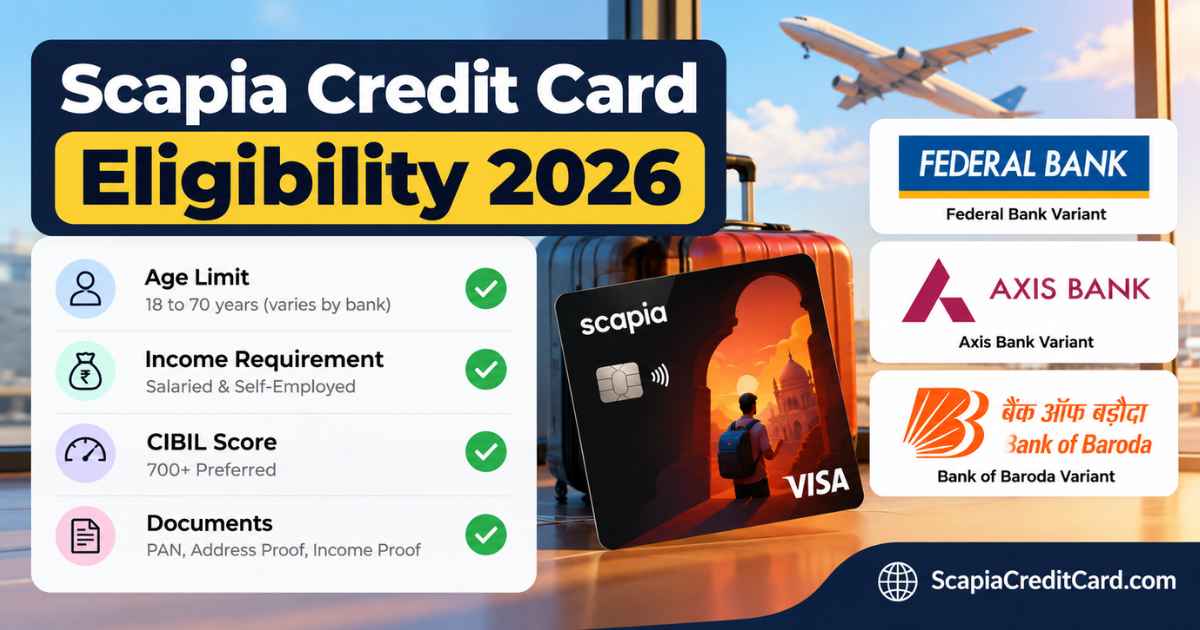
This guide covers the age limits, income requirements, credit score expectations, and documents needed for each variant in 2026, plus the most common reasons applications get rejected – and what to do about them.
Scapia Credit Card Eligibility at a Glance
Short on time? Here is the quick version:
- Age: 21–65 years for the Federal Bank variant; 18–70 years for the Axis Bank variant; 21–60 years for the Bank of Baroda Variant.
- Residency: Must be a resident of India. Some variants also accept NRIs.
- Credit score: A CIBIL score of 700+ is preferred; 730+ gives you the strongest chance.
- Income: Salaried applicants generally need around ₹25,000+ per month; self-employed applicants need a higher annual income (roughly ₹4 lakh+ per year).
- Documents: PAN card, address proof, and income proof (payslips, bank statements, or ITR).
- Application: Fully digital through the Scapia app with video KYC – no branch visit.
- Bank rule to know: For the Federal Bank variant, you generally cannot already hold another Federal Bank credit card.
Final approval always rests with the issuing bank, which applies its own credit policy beyond these baseline criteria. If you are still comparing options, read our Scapia Credit Card benefits guide alongside this page.
Three Banks, Three Rulebooks: Why Eligibility Depends on the Variant
Most articles about Scapia eligibility were written when only the Federal Bank variant existed. Since then, Scapia has partnered with Bank of Baroda and, most recently, Axis Bank – each with its own age band, income expectations, and documentation norms. Treating them as one card is why you will find contradictory figures online: one site says the minimum age is 18, another says 21, another says 23. All three can be correct – for different variants.
Before you check your own eligibility, figure out which variant you are being offered in the Scapia app. The sections below break down the criteria by issuer so you are comparing apples to apples.
Scapia Credit Card Eligibility Criteria Explained
1. Age Requirement
The minimum and maximum age depend on the issuing bank:
- Federal Bank variant: 21 to 65 years for the primary cardholder.
- Axis Bank variant: 18 to 70 years for the primary cardholder.
- Bank of Baroda variant: 21 to 60 years for the primary cardholder.
If you are between 18 and 21, the Axis Bank variant is the only one that officially accepts your application. Applicants above 65 are similarly limited to the Axis variant.
2. Nationality and Residency
You must be a resident of India to apply for any Scapia Credit Card variant. Some issuer terms also extend eligibility to Non-Resident Indians (NRIs), particularly on the Federal Bank variant. Foreign nationals without Indian residency are not eligible.
One practical catch: the issuing bank must service your PIN code. Applicants have reported rejections at the final address step when their area is outside the bank’s coverage – the app may let you proceed and then decline you. If that happens, it is a serviceability issue, not a credit issue, and reapplying later can work as coverage expands.
3. Credit Score (CIBIL)
Your credit score is the single biggest factor after the basics. Here is how it generally plays out:
- 700+: the commonly cited comfort zone for approval.
- 730–750+: the strongest position; several issuer-linked campaigns cite 730+ as their benchmark.
- Below 700: approval becomes difficult but is not impossible – it depends on income stability and banking history.
- New-to-credit (no score yet): you may be declined, since the bank has no repayment history to assess. Some co-branded campaigns explicitly exclude new-to-credit applicants.
Check your CIBIL score free before applying. A hard inquiry from a rejected application still shows up on your report, so it is worth knowing where you stand first.
4. Income Requirement
Scapia’s partner banks do not always publish a hard income floor, but the practical thresholds reported by applicants and issuer-linked sources are:
- Salaried: roughly ₹25,000–₹30,000 per month of stable income.
- Self-employed: roughly ₹4 lakh+ per year of documented income.
Stability matters as much as the number. A salaried applicant with 12 months of regular credits into the same account is a simpler “yes” for underwriting than a higher-earning applicant with irregular, undocumented income.
5. Employment Type: Salaried vs Self-Employed
Both salaried and self-employed applicants are eligible. What differs is how you prove income:
| Employment type | Typical income proof accepted |
|---|---|
| Salaried | Latest 1–3 months salary slips, Form 16, or recent bank statements showing salary credits |
| Self-employed | Income Tax Returns (ITR) for the last 1–2 years, business bank statements, audited financials where applicable |
Self-employed applicants should expect slightly closer scrutiny and a higher effective income bar. Having your ITRs filed and bank statements tidy before you apply avoids the most common documentation delays.
6. Existing Relationship With the Issuing Bank
For the Federal Bank variant, the bank has historically followed a one-card policy: if you already hold a Federal Bank credit card, your Scapia application can be declined. This rule is specific to Federal Bank – it does not affect the Axis Bank or Bank of Baroda variants.
Having a savings account or other relationship with the issuing bank is not a requirement, and no competitor source lists it as mandatory. That said, an existing banking relationship can make verification smoother.
Eligibility by Variant: Federal Bank vs Axis Bank vs Bank of Baroda
| Criteria | Federal Bank Scapia Card | Axis Bank Scapia Card | Bank of Baroda Scapia Card |
|---|---|---|---|
| Age | 21–65 years | 18–70 years | 21-60 years |
| Residency | Indian resident; NRIs accepted on some terms | Indian resident | Indian resident |
| Credit score | 700+ preferred, 750+ ideal | 730+ benchmark reported; 700+ preferred | Good credit history required |
| Salaried income | ~₹25,000+/month | ~₹25,000–₹30,000/month | ~₹25,000+/month |
| Self-employed income | ~₹4 lakh+/year | ~₹4 lakh+/year | ~₹4 lakh+/year |
| Existing card rule | Cannot hold another Federal Bank credit card | No such restriction reported | No such restriction reported |
| Annual fee | Lifetime free | Lifetime free | Lifetime free |
| Application | 100% digital via the Scapia app with video KYC | ||
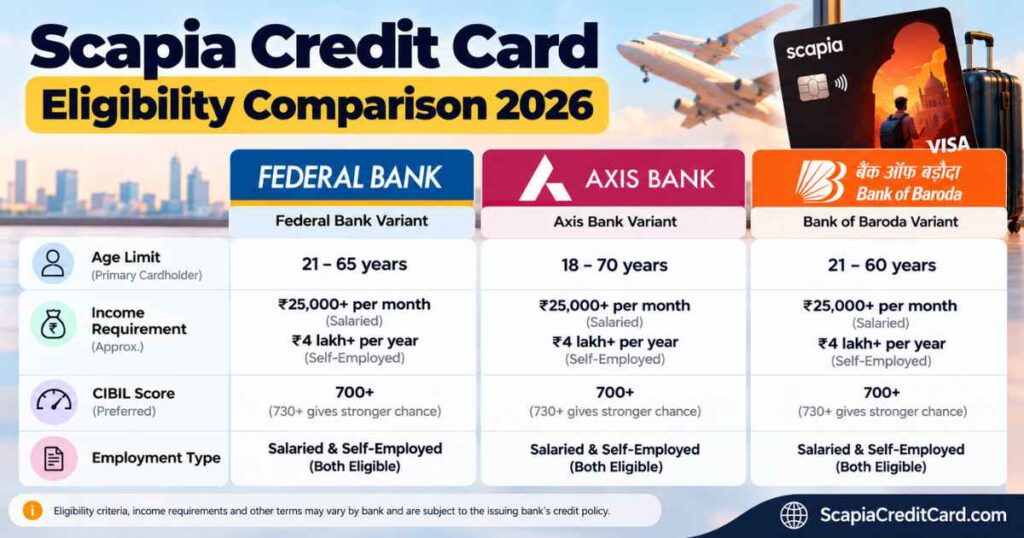
All three variants share the card’s headline features – lifetime-free pricing and zero forex markup on international spending. For the full feature breakdown, see our Scapia Credit Card review and the zero forex markup guide.
Documents Required for the Scapia Credit Card
The application is paperless – you upload photos or scans in the app. Keep these ready before you start:
| Category | Accepted documents |
|---|---|
| Identity proof | PAN card (mandatory), Aadhaar card, passport, voter ID, or driving licence |
| Address proof | Aadhaar card, passport, driving licence, utility bill (electricity/telephone), or rental agreement |
| Income proof (salaried) | Latest salary slips, Form 16, or bank statements showing salary credits |
| Income proof (self-employed) | Income Tax Returns, business bank statements |
| Photograph | Recent passport-size photograph |
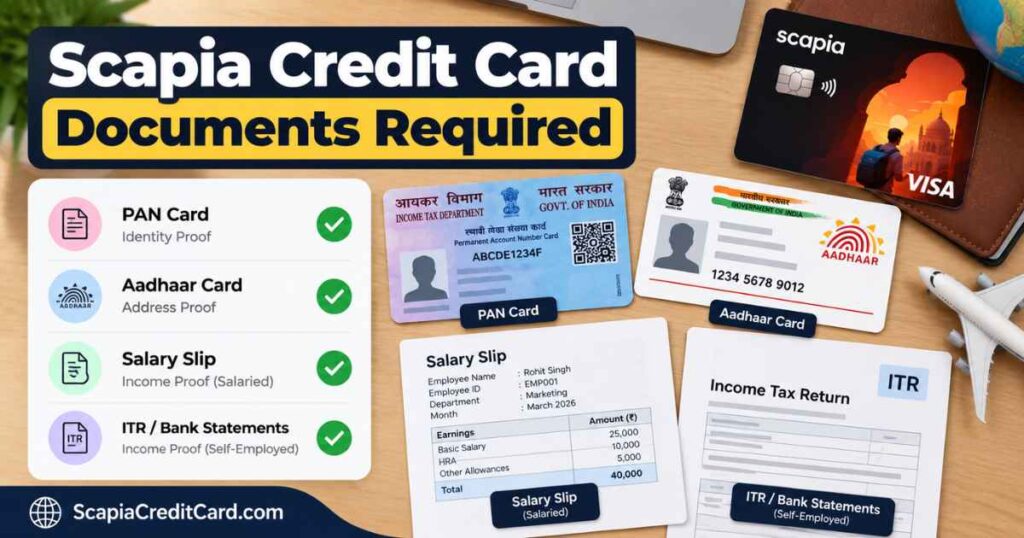
Two things that trip people up: use the mobile number linked to your Aadhaar, and complete video KYC from your actual location – applications have been rejected when VKYC is done far from the address on record. For the Axis Bank variant, the documented checklist is PAN card or Form 60, income proof (latest payslip / Form 16 / IT return), and residence proof such as a driving licence or utility bill.
How to Apply for the Scapia Credit Card (Step by Step)
- Go to Scapia Credit Card Application Page and tap “Apply Now“.
- Fill in your details – personal information, employment type, and income.
- Upload your documents – PAN, address proof, and income proof as prompted.
- Complete video KYC – a short video verification inside the app, usually taking a few minutes.
- Wait for approval – decisions typically arrive within 24–72 hours. The virtual card is usable online almost immediately after approval; the physical card arrives by courier in roughly 2–7 working days.
You can track your Scapia credit card application status after submitting, and once the card arrives, follow our activation guide to set your PIN and start using it.
Common Reasons Scapia Credit Card Applications Get Rejected
- Low or thin credit history – the most common reason. A score below 700, or no credit history at all, leads many declines.
- Already holding a Federal Bank credit card – the one-card policy on the Federal variant.
- Unserviceable PIN code – your address is outside the issuing bank’s current coverage area.
- Income proof mismatch – declared income does not match the documents uploaded.
- VKYC location mismatch – video KYC completed far from your Aadhaar or communication address.
- Incomplete or blurry documents – surprisingly common with paperless applications; re-upload clearly and reapply.
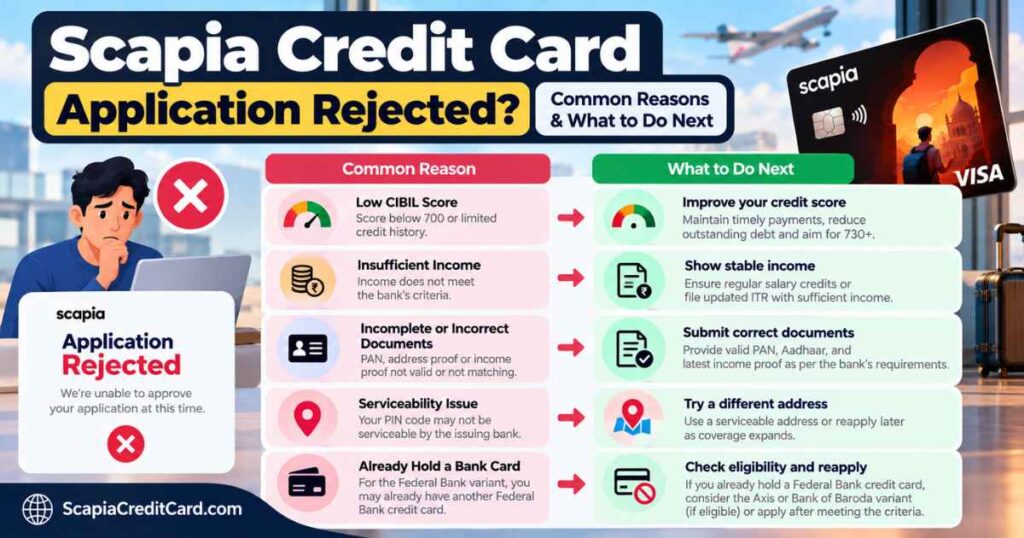
A rejection is not permanent. Most of these are fixable, and you can reapply once the underlying issue is resolved – though it is wise to wait a few months between attempts to avoid stacking hard inquiries on your credit report. If you are approved with a lower limit than expected, our guide on increasing your Scapia credit card limit covers your options.
Not Eligible Yet? Here’s What to Do
If you fall short on any criterion, the fix is usually time plus a few deliberate steps:
- Build your credit score: pay all existing EMIs and bills on time, keep credit utilisation below 30%, and avoid applying for multiple cards at once. Even 3–6 months of clean history moves the needle.
- New to credit: consider starting with a secured (FD-backed) card from any bank, use it responsibly for 6–12 months, then apply for Scapia.
- Underage for the Federal variant: if you are 18–20, check whether the Axis Bank variant is offered to you in the app.
- Income just below the bar: wait until your documented income crosses the threshold rather than overstating it – mismatches are an easy rejection.
- Rejected once: identify the likely cause from the list above, fix it, and reapply after 3–6 months.
Should You Apply? A Quick Decision Check
Apply with confidence if you are 21+ (or 18+ for the Axis variant), an Indian resident with a 700+ CIBIL score, stable documented income, and no existing Federal Bank credit card. Hold off if your score is below 650, you have no credit history, or your income documents are not in order – a few months of preparation will serve you better than a rejection. And if travel perks are what drew you in, the lounge access guide, Scapia Coins rewards explainer, and UPI payments guide will help you judge whether the card fits your spending pattern. Also review the fees and charges so there are no surprises.
Frequently Asked Questions
-
What is the minimum age for the Scapia Credit Card?
The minimum age is 21 for the Federal Bank / Bank of Baroda variant and 18 for the Axis Bank variant. If you are 18–20, only the Axis Bank variant is open to you.
-
What credit score do I need for the Scapia Credit Card?
A CIBIL score of 700+ is generally preferred, and 730+ puts you in the strongest position. Applicants with no credit history (new-to-credit) may be declined since the bank cannot assess repayment behaviour.
-
What is the minimum salary required for the Scapia Credit Card?
There is no single published figure across all variants, but salaried applicants generally need around ₹25,000-₹30,000 per month, and self-employed applicants need roughly ₹4 lakh+ per year of documented income. Final approval depends on the issuing bank’s credit policy.
-
Can NRIs apply for the Scapia Credit Card?
Some issuer terms extend eligibility to Non-Resident Indians, particularly on the Federal Bank variant. Check the variant offered to you in the Scapia app for the current NRI policy.
-
Can I get the Scapia Card if I already have a Federal Bank credit card?
Generally no for the Federal Bank variant, which has followed a one-card policy. You can still apply for the Axis Bank or Bank of Baroda variants, which do not carry this restriction.
-
Which documents are required to apply?
PAN card (mandatory), an address proof such as Aadhaar or a utility bill, income proof (salary slips or Form 16 for salaried; ITR and bank statements for self-employed), and a recent photograph. The entire process is digital with video KYC.
-
Can students apply for the Scapia Credit Card?
Students with no income or credit history will usually not meet the criteria. If you are a student with a part-time income, a 700+ score is still unlikely without prior credit history – building history with a secured card first is the more realistic path.
-
How long does Scapia Credit Card approval take?
Approval typically takes 24–72 hours after you submit the application and complete video KYC. The virtual card is usable online almost immediately after approval, and the physical card arrives in about 2–7 working days.